
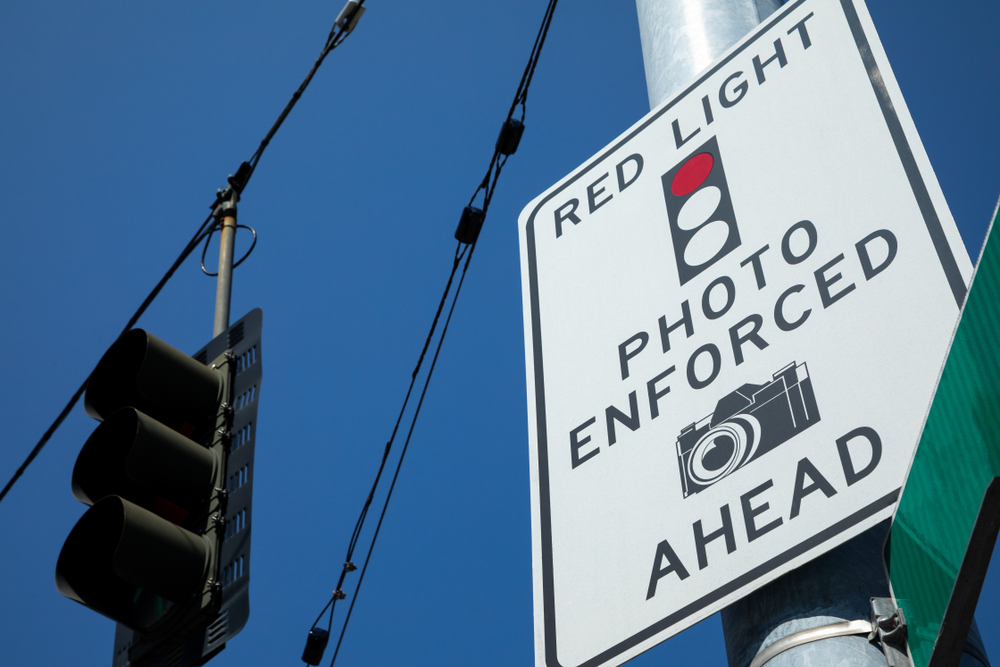
Red light camera tickets have been hitting California mailboxes for years.
Drivers routinely cough up hundreds of dollars when those flash bulbs catch them.
But California drivers discovered one loophole that has officials scrambling.
The enforcement power Gavin Newsom doesn't want you to know about
Traffic experts are revealing what California officials kept quiet for years.
This isn’t legal advice but some experts are claiming the state can't actually force drivers to pay red light camera tickets.
Jay Beeber with the National Motorists Association laid out the ugly truth for California's enforcement system.
"The only thing they can do is, they can send it to a collection agency and a collection agency has no power over you," Beeber explained to CBS. "They can't send it to a credit reporting agency, so it doesn't affect your credit."
That's right — ignoring these tickets won't trash your credit score or get your license suspended.
Collection agencies can call and send letters all day long.
But they've got zero power to make drivers actually pay up.
Jorian Goes, founder of Ticket Snipers, pointed out the cameras themselves are riddled with problems.
"They have calibration issues with the sensors, the cameras, and then there is a non-uniformed declarant that looks over the footage that works for the camera company and the city that actually issues the violations," Goes told CBS.
Unlike traditional traffic stops where a uniformed officer witnesses the violation firsthand, these camera tickets rely on third-party reviews from people who work for the camera companies.
They're not peace officers.
They're reviewing footage for the same companies getting paid to issue citations.
That creates a massive conflict of interest most drivers don't realize exists.
Cities are desperate to close the loophole before word spreads
California cities watched this enforcement gap bleed millions in uncollected fines.
They couldn't let drivers figure out they could simply ignore these tickets forever.
Senate Bill 720 passed in October 2025 to plug the hole.
The new law allows cities to classify red light camera violations as civil penalties instead of criminal infractions starting January 1, 2026.
That sounds like a tiny bureaucratic shift.
But it changes everything about how these tickets work.
The traditional system required clear photos of the driver's face to prove who committed the violation.
That's why so many tickets got dismissed — blurry photos, wrong angle, driver not identifiable.
Under SB 720, cities only need a license plate photo.
They ticket the vehicle's registered owner regardless of who was actually driving.
The base fine drops from nearly $500 to $100 for first-time violations.
But repeat offenses escalate fast — $200 for the second ticket within three years, $350 for the third, and $500 for four or more violations.
Cities like this system because it's easier to collect and generates steady revenue streams.
The new law removes the biggest obstacle that let drivers challenge tickets and win.
California buried enforcement problems for years while collecting billions
Red light camera programs generated massive revenue for California cities even when the tickets were unenforceable.
Most drivers just paid up without questioning whether they legally had to.
The system relied on ignorance and intimidation.
Threatening letters from collection agencies scared people into sending checks even though those agencies couldn't actually do anything.
California courts restored nearly half a million licenses in 2020 that had been suspended over unpaid traffic tickets.
A 2020 California Court of Appeal ruling found the DMV was illegally suspending licenses for unpaid camera tickets.
"An order to appear in court is not equivalent to a written promise to appear," Judge Mark B. Simons wrote.
Camera tickets mailed to drivers don't include the signature promising to appear that makes traditional tickets enforceable.
That legal loophole existed for years while California collected an estimated $9.7 billion in unpaid traffic ticket debt by 2016.
Beeber pointed out that many violations cameras catch are things officers would never cite.
"They're a fraction of a second violations that nobody can even see with the naked eye, which the violator wasn't even aware that they actually committed the violation — or they're slow-rolling right turns," Beeber said.
Traffic attorneys have built entire practices around getting camera tickets dismissed.
California Vehicle Code requires clear photos of both the driver's face and license plate.
Missing or obstructed warning signs within 200 feet of intersections invalidate tickets.
Yellow lights that don't meet minimum duration standards for the posted speed limit create valid defenses.
Any calibration issues with the cameras or sensors can get tickets tossed.
The cameras themselves often can't prove violations occurred beyond reasonable doubt when reviewed frame by frame.
That's a fundamental requirement for any traffic citation to hold up.
Senate Bill 720 eliminates the safeguards that protected drivers
The new civil penalty system strips away most legal defenses that worked under the old criminal citation model.
Cities no longer need to prove who was driving.
They don't need clear facial identification photos.
The burden shifts entirely onto vehicle owners to prove they weren't driving or contest the ticket through an administrative process.
That administrative hearing system gets run by the same agencies issuing the tickets.
It's not an independent court reviewing the evidence.
SB 720 allows cities to collect directly without the usual court oversight that criminal violations require.
Revenue from these fines must go toward street safety improvements under the new law.
But cities gain a powerful new collection tool that doesn't require actual law enforcement involvement.
The program treats red light violations like parking tickets — purely civil matters that can be enforced through administrative channels.
Drivers can still request hearings and challenge tickets.
But the deck is stacked against them now that cities control the entire process from citation to collection.
Privacy advocates worried about expanded surveillance got token concessions.
The law requires warning signs and allows a 60-day grace period before new cameras start issuing tickets.
That's cold comfort for drivers who just lost their strongest legal defenses against questionable automated enforcement.
Sources:
- Stephen Rivers, "Californians Keep Paying Camera Tickets, But Some Say They Might Not Have To," Carscoops, January 23, 2026.
- California Legislative Information, "Senate Bill No. 720," October 13, 2025.
- Walk San Francisco, "Governor Newsom signs the red light camera bill, SB 720," October 15, 2025.
- Chain Cohn Clark, "Speed Limits to Self-Driving: 2026 California Traffic Safety Laws," December 31, 2025.
Related posts:

 New Mexico’s Democrat AG Says He Caught Facebook Misleading Users 43 Million Times and Wants the Payday
 A Wall Street Analyst Just Raised the Odds on Musk’s Boldest Move to 90 Percent