
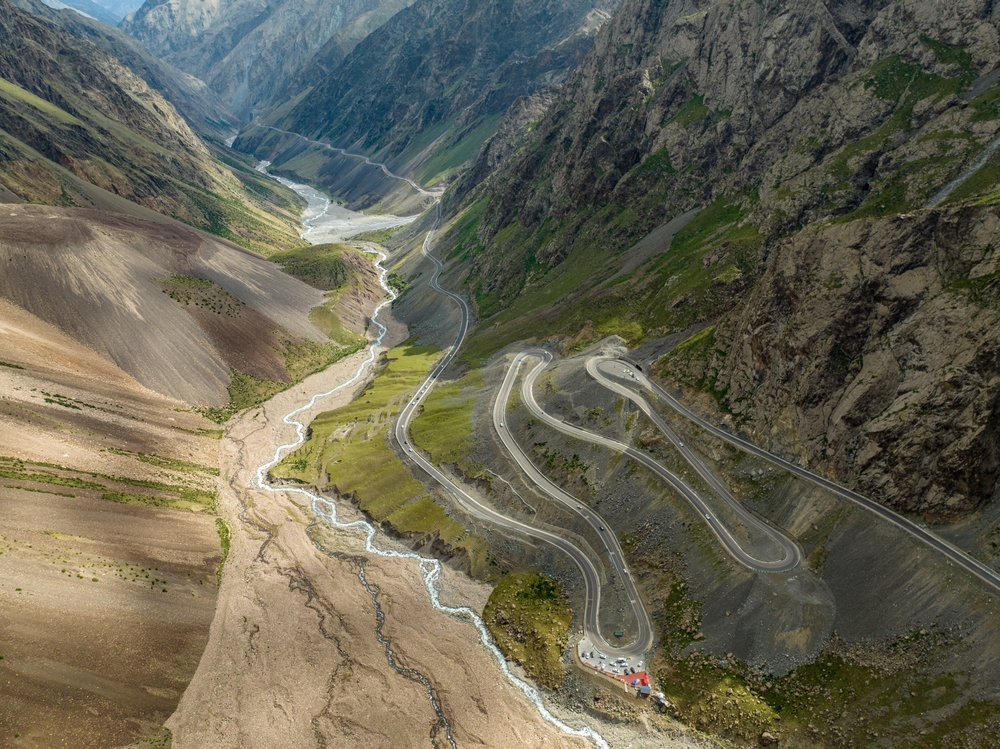
Millions of Americans have dreamed of buying an adventure bike – throwing a leg over something capable, pointing it at a dirt road, and just going.
Sales numbers prove it: adventure motorcycles are one of the only segments in a shrinking U.S. market actually growing right now, with BMW Motorrad alone moving a record 210,408 units in 2024.
What nobody tells the new wave of riders flooding into the sport is that the most dangerous mistake you can make doesn't happen at speed – and a dashcam on a Chinese mountain pass just caught one rider learning that the hard way.
The Whiskey Throttle Motorcycle Mistake That Ends Rides
The incident unfolded on a narrow dirt road in China's mountains in February, two riders picking their way uphill at less than 10 mph.
One rider – bright orange jacket, adventure bike under her – starts to lose balance.
It's a low-speed wobble, the kind that looks totally recoverable.
Instead of easing off the throttle or simply laying the bike down, she does what almost every panicking rider does: she grabs on harder.
On a motorcycle, grabbing harder means twisting the throttle open.
The bike rockets across the road, launches over a dirt mound, and sends her airborne off what the footage shows is a cliff edge.
Her riding companion watches from a few feet away, apparently unable to process what just happened.
Chinese media reported she walked away without serious injury.
The bike almost certainly did not fare as well.
Why Adventure Bike Riders Are Most at Risk
That instinct – grip tighter when you're scared – has a name every serious rider knows: whiskey throttle.
It happens because the human body's panic response doesn't distinguish between "grab a railing to stop a fall" and "grip motorcycle handlebars."
Both feel identical to your nervous system in the split second before rational thought kicks in.
On a motorcycle, tightening your grip in panic rolls the throttle open – increasing power exactly when you need to cut it.
The result is a self-reinforcing loop: bike accelerates, rider panics harder, rider grips tighter, bike accelerates more.
At less than 10 mph, it sent this rider off a mountain.
The term traces back to the observation that fear and inexperience produce the same loss of fine motor control as intoxication – no actual whiskey required.
The adventure bike boom has put hundreds of thousands of new riders on machines they aren't necessarily ready for.
BMW, KTM, Honda, Yamaha – every major manufacturer is racing to capture riders who want to go off-road but may have little background doing it.
The global ADV market hit roughly $37 billion in 2024 and is projected to nearly double by 2034.
The safety data behind that boom is brutal: more than half of riders involved in crashes had less than five months of experience on their motorcycle at the time, and 92% of all crash-involved riders were self-taught.
U.S. motorcycle fatalities reached 6,335 in 2023 – the highest number ever recorded, a 35% increase over the prior decade.
Mountain dirt roads add a dimension of consequence that no parking lot drill prepares you for.
How to Prevent Whiskey Throttle Before It Happens to You
Every riding instructor will tell you the same thing: whiskey throttle is too fast for conscious intervention in the moment.
The only real prevention is building throttle discipline into muscle memory before you need it – deliberate low-speed practice, proper body positioning so your weight stays off the handlebars, and knowing your terrain before you commit to it.
The rider in orange got the luckiest possible ending to the worst possible lesson.
Most riders who make the same mistake on the same terrain don't.
Sources:
- Brad Anderson, "Watch A Rider Discover Why Whiskey Throttle Is Every Biker's Nightmare," Carscoops, February 23, 2026.
- "How ADV Bikes Are Dominating the Motorcycle Industry," Riders Share, 2025.
- Elliot Bourne, "What Percent of Motorcycle Riders Crash?" Bourne Law Firm, November 24, 2025.
- "Whiskey Throttle vs. Panic Rev," MotoSport.
- "Adventure Motorcycle Market Size, Share, Trends Analysis, 2034," Expert Market Research, 2024.
Related posts:

 Her Boyfriend Flew First Class While She Sat in Economy and the Internet Passed Judgment
 Classic Film Star Eva Marie Saint Passes at 102 and Took a Piece of Old Hollywood With Her
 A Federal Judge Just Blocked ByteDance From Escaping a Lawsuit Over Stolen Creator Videos