
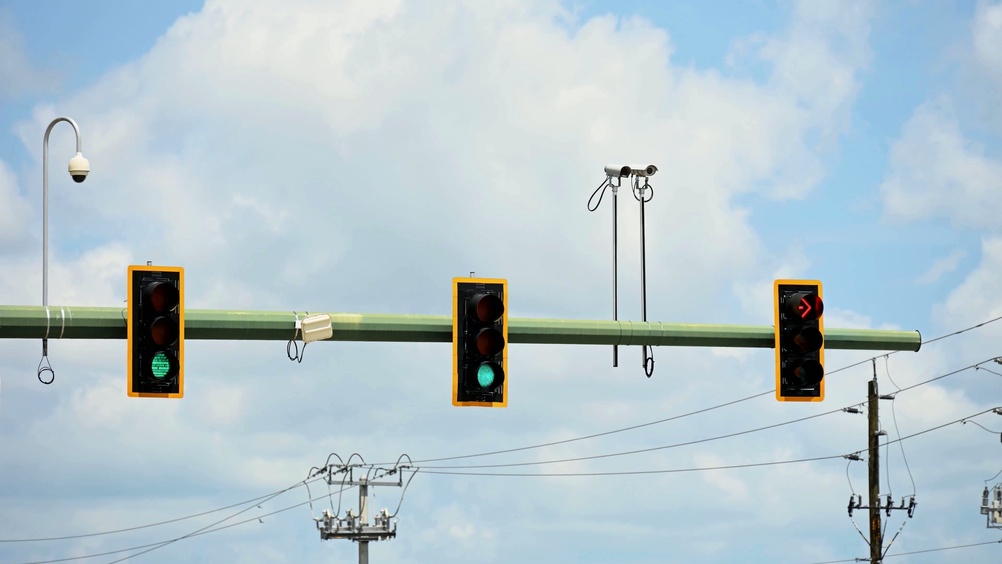
A Texas constable told an AI camera company to come get its garbage out of his county.
Cameras like the ones in his county are now at the heart of a federal appeals case over warrantless searches.
Prosecutors argued your movements on public roads are not protected, and the chief judge fired back with one question.
Defense Says Flock Knows When You Go to Church on Sunday
The case is United States v. Brownlee, and a three-judge Fifth Circuit panel heard it on October 5.
Charles Brownlee was convicted of robbing a series of cash stores at gunpoint around Dallas-Fort Worth.
Nobody is shedding tears for an armed robber.
What matters is how police found him.
Eyewitnesses described the getaway SUV, and investigators ran that description through a database run by Flock Safety, the company behind those AI cameras.
The system turned up an SUV that had passed near several of the robberies, then showed police where it was parked at that moment.
No warrant was involved, and no license plate number was known when the search began.
Assistant Federal Public Defender Matthew Wright warned that a database like that maps out a person's whole routine.
The morning commute, the late nights, the Sunday service – all of it sitting on a server.
To Wright, that is a search under the Fourth Amendment.
Justice Department lawyer Michael Weisbuch argued the opposite.
In his view, nothing you do on a public road is private, and anybody behind the wheel should expect to be watched from time to time.
Chief Judge Jennifer Walker Elrod, a George W. Bush appointee, wasn't buying it.
She asked what happens when the cameras end up "on every corner, which it's soon to be."
Elrod sat alongside Judge Priscilla Richman, another Bush appointee, and Biden appointee Irma Carrillo Ramirez.
120,000 Flock Cameras Logging 20 Billion Scans a Month
Elrod's warning isn't far off.
By Flock's count, the company has more than 120,000 cameras up in 49 states, logging upward of 20 billion vehicle scans a month.
"Flock has assembled an unprecedented national surveillance network," said Sen. Josh Hawley of Missouri.
Texas towns have started pulling the plug.
Pflugerville's city council voted unanimously to cut off all 28 of its cameras, and Mayor Doug Weiss said the city could no longer trust the vendor.
That Texas constable is John Shirley of Hood County, where commissioners had the county's three Flock cameras disconnected and covered.
Shirley said the cameras had been recording ordinary people as they went about their lives.
At a Senate hearing in September, Lindsey Isaacs testified that she was wrongly accused of murder on the strength of Flock footage that never held up.
She sat in jail for 13 days, 86 hours of it in solitary confinement.
"They don't want to be tracked and treated like criminals," Hawley said of ordinary Americans.
In Oklahoma, U.S. District Judge Sara Hill tossed the evidence in a drug case on October 1.
A Tulsa County deputy had tailed a Mazda SUV with California plates and run it through Flock without any sign of a crime.
That search pulled up more than 50 sightings of the vehicle in several states over about a month.
Hill wrote that the search was "a type of indiscriminate mass surveillance."
The Supreme Court Already Drew This Line in Carpenter
The Supreme Court has been here before.
In 2012, the justices ruled unanimously that police crossed the line when they stuck a GPS tracker on a suspect's vehicle and followed him for 28 days without a valid warrant.
In 2018, Chief Justice John Roberts wrote in Carpenter v. United States that police need a warrant to pull months of a person's cellphone location records.
In January 2026, a third Bush appointee showed exactly where that line sits for Flock.
U.S. District Judge Mark Davis upheld the 176 Flock cameras in Norfolk, Virginia, because the network still left thousands of blind spots.
But in a footnote, Davis warned the answer could change once a city puts a camera "at the next street corner, and the next, and the next."
That is the future Elrod sees coming.
Every new camera Flock bolts to a light pole pushes America closer to it.
Weisbuch told the panel the political process would keep things from going that far.
The Founders didn't leave liberty to the political process.
They wrote the Fourth Amendment because British officers used general warrants to rummage through colonists' homes at will.
A database that can tell the government which church parking lot you pull into every Sunday is a general warrant with a cloud subscription.
Robert Frommer of the Institute for Justice says the top reform is a warrant requirement before police dig through stored location data.
That's not soft on crime.
The cops can keep their cameras.
They just need to ask a judge first.
Sources:
- Christina van Waasbergen, "Fifth Circuit wrestles with constitutionality of warrantless Flock searches," Courthouse News Service, October 5, 2026.
- Stepheny Price, "Hawley rips Flock's sprawling surveillance web as Texas cities cut cameras over privacy and data fears," Fox News, August 26, 2026.
- Virginia Grace McKinnon, "Always Watching: Congress Begins Investigating Flock Cameras," The Daily Signal, September 24, 2026.
- David Manney, "Flock's Massive License-Plate Database Just Hit a Fourth Amendment Wall," PJ Media, October 3, 2026.
- Dallas Express, "Federal Judge Rules Warrantless Flock Search Violated Fourth Amendment," Dallas Express, October 3, 2026.
- U.S. Supreme Court, "Carpenter v. United States," U.S. Supreme Court, June 22, 2018.
- U.S. District Court for the Eastern District of Virginia, "Schmidt v. City of Norfolk," U.S. District Court for the Eastern District of Virginia, January 27, 2026.

